
Montgomery County Circuit Courts Overview
The Circuit Court is Tennessee's general trial court, and it is the main trial court in Montgomery County. There is no trial-level "district court" here. Circuit judges hear civil cases, criminal cases, and appeals from General Sessions, Juvenile, and Municipal courts. Montgomery County sits in the 19th Judicial District, which it shares with Robertson County, and five Circuit judges serve in Parts I through V.
A separate Chancery Court hears equity matters. Together, Circuit and Chancery cover most serious cases in the county, while General Sessions and Juvenile handle limited-jurisdiction matters.
The Tennessee Administrative Office of the Courts explains how these courts fit together.
The screenshot below is the Tennessee AOC courts overview page.
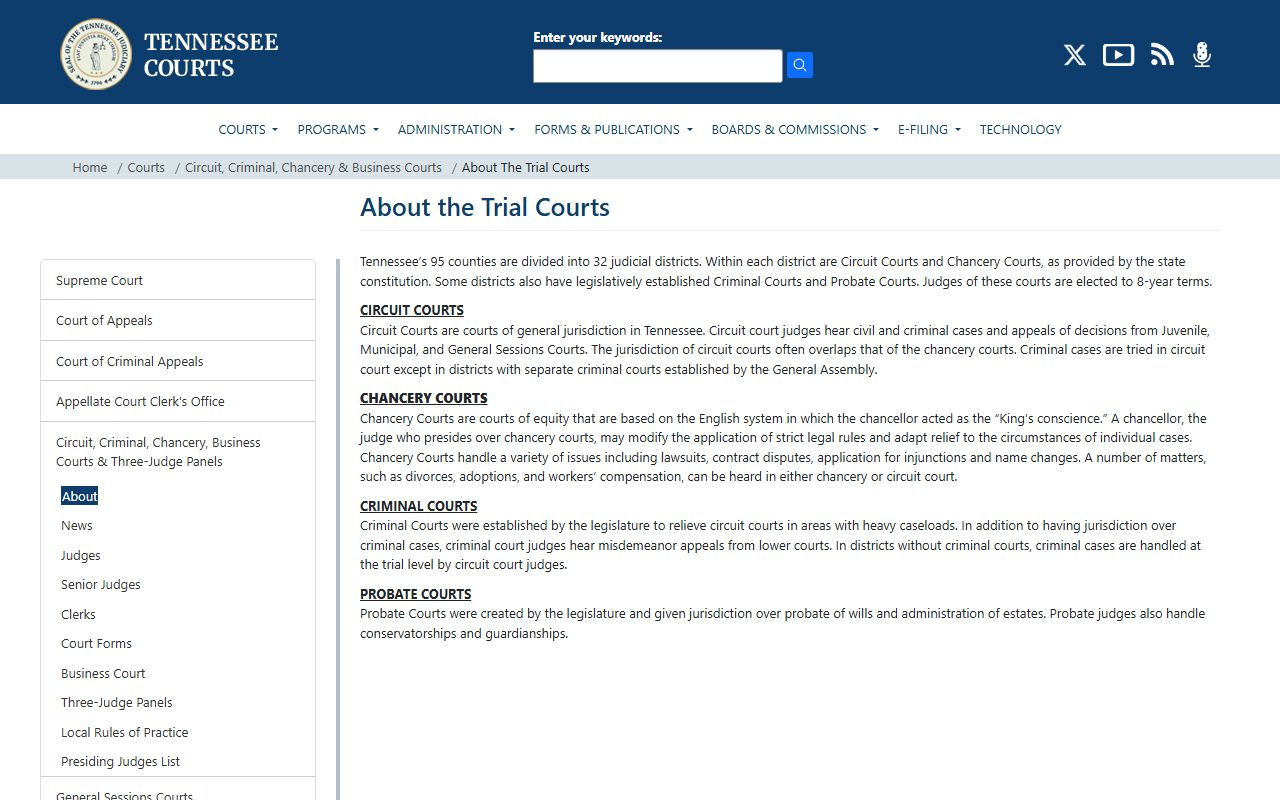
It describes the roles of Circuit, Chancery, Criminal, and Probate Courts across Tennessee. Some districts add a dedicated Criminal Court or Probate Court by statute. Montgomery County does not run a separate trial-level district court, so people searching for one should look to Circuit Court instead.
List of Montgomery County Circuit Court Judges
Five Circuit judges sit in the 19th Judicial District at the Courts Center on Millennium Plaza. Each serves an eight-year term shown as 2022 through 2030.
| Court Part | Judge | Address | Phone |
|---|---|---|---|
| Circuit Court, Part I | Adrienne Fry | 2 Millennium Plaza, Clarksville, TN 37040 | 931-648-5704 |
| Circuit Court, Part II | Bill Goodman | 2 Millennium Plaza, Clarksville, TN 37040 | 931-648-5704 |
| Circuit Court, Part III | Joel Wallace | 2 Millennium Plaza, Clarksville, TN 37040 | 931-648-5704 |
| Circuit Court, Part IV | Robert T. Bateman | 2 Millennium Plaza, Clarksville, TN 37040 | 931-648-5704 |
| Circuit Court, Part V | Katy Olita | 2 Millennium Plaza, Clarksville, TN 37040 | 931-648-5704 |
Chancery Court is led by Chancellor Ben Dean at the same Courts Center. The shared phone line routes callers to the right court part, and the Courts Center holds several courtrooms, so the docket tells you which part to report to. When you have a case, note the part number, since that ties to a specific judge and courtroom.
Circuit Court vs. General Sessions vs. Chancery Court
The three courts split the work by case type and seriousness. Knowing which court hears a matter tells you where the record lives and who clerks it.
| Court | Type | Clerk |
|---|---|---|
| Circuit Court | General trial court; appeals from lower courts | Circuit Court Clerk |
| General Sessions | Misdemeanors, traffic, smaller civil | Circuit Court Clerk |
| Chancery Court | Equity, divorce, estates, name changes | Clerk and Master |
Juvenile Court is also clerked by the Circuit Court Clerk, with access limited by confidentiality rules. The practical takeaway is simple. If your matter is a divorce or an estate, look to Chancery and the Clerk and Master. If it is a crime, a traffic case, or a civil dispute, look to Circuit or General Sessions and the Circuit Court Clerk. That one distinction answers most questions about where a Montgomery County case lives.
How a Case Moves Through the Montgomery County System
Most cases start in a lower court and can rise on appeal. A misdemeanor or traffic matter often begins in General Sessions, while serious crimes and larger civil cases go to Circuit Court. Appeals from the trial courts go to the state intermediate courts.
Case flow: General Sessions Court › Circuit Court › Tennessee Court of Appeals or Court of Criminal Appeals › Tennessee Supreme Court
Federal cases follow a separate track through the U.S. District Court for the Middle District of Tennessee, with appeals to the Sixth Circuit. Bankruptcy goes to the U.S. Bankruptcy Court for the Middle District, and federal dockets are searched through PACER rather than the county clerk. Those federal courts are not part of the Montgomery County system, but they matter when a case involves federal law.
The screenshot below is the U.S. Court of Appeals for the Sixth Circuit.
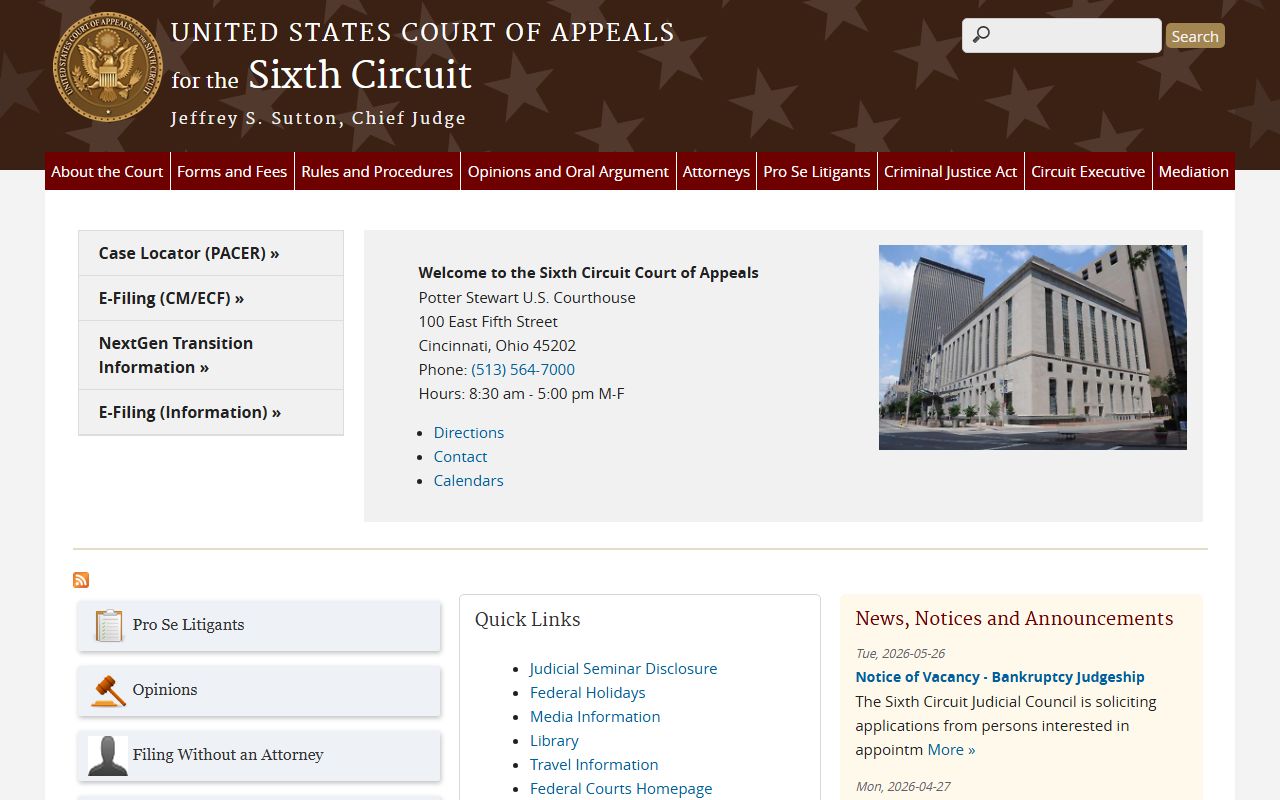
Federal appeals from Tennessee, including Montgomery County, are heard by the Sixth Circuit.
Civil, Family, and Criminal Divisions
Circuit Court work falls into civil, family, and criminal matters. Civil cases cover disputes over money, contracts, and injuries. Family matters can overlap with Chancery, especially divorce. Criminal cases are prosecuted by the District Attorney General, Robert J. Nash, whose office serves Montgomery and Robertson Counties.
The screenshot below is the county's District Attorney page.
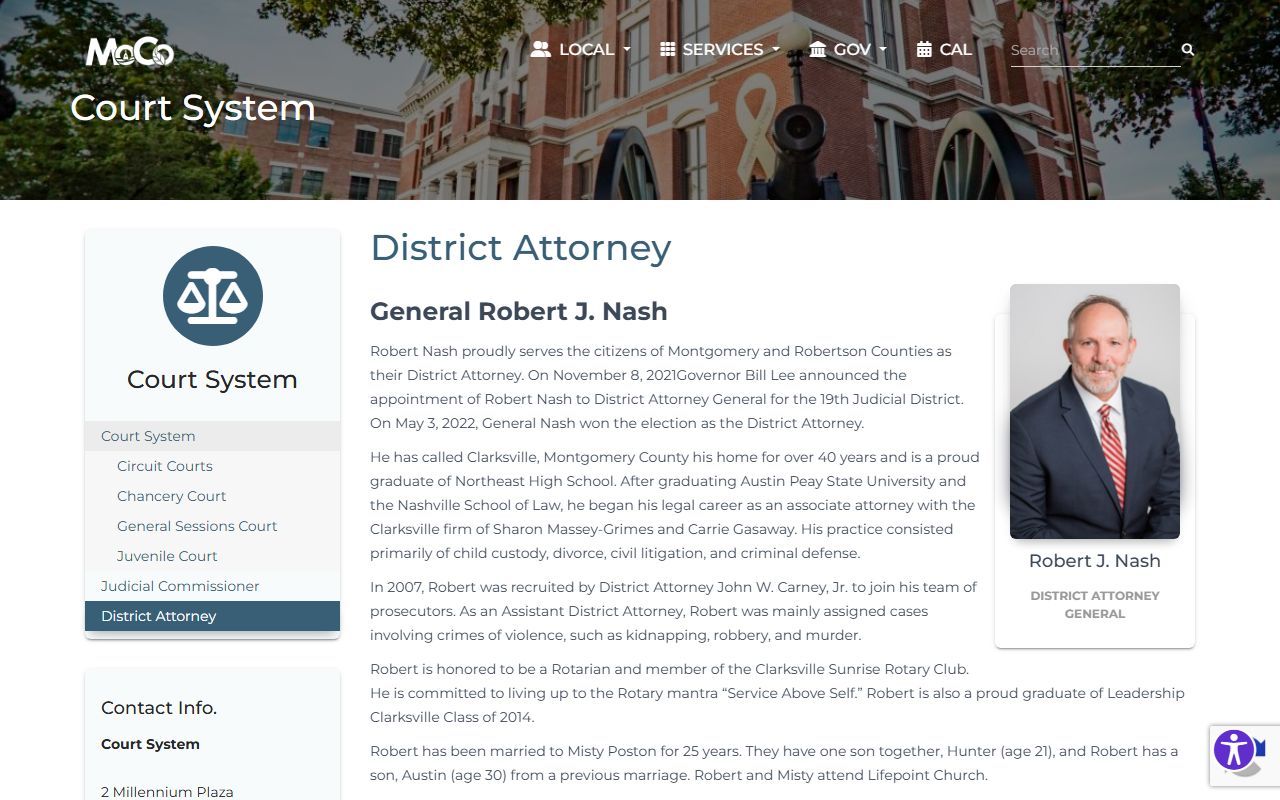
The District Attorney prosecutes state criminal cases, while the District Public Defender represents qualifying indigent defendants. A defendant who cannot afford a lawyer can ask the court to appoint counsel, usually at arraignment, by completing an affidavit of indigency. The two roles are distinct: the District Attorney works to prove the state's case, and the Public Defender works to defend the accused.
The 19th Judicial District
Montgomery County is part of the 19th Judicial District with Robertson County. The district shares its District Attorney General, District Public Defender, and Chancellor across both counties. Roger Nell serves as District Public Defender and has led the office for more than twenty years. The district structure is why some officials and e-filing systems serve both counties at once.
For the offices that keep district records, see the Circuit Court Clerk and the Clerk and Master. The District Attorney General's office is at 200 Commerce Street, and the Public Defender's office is at 112 S. Second Street, both in Clarksville. Sharing these offices across two counties is common in Tennessee, where judicial districts often cover more than one county.
Magistrate and Lower Courts
Below Circuit and Chancery sit the limited-jurisdiction courts. General Sessions handles misdemeanors, traffic, and smaller civil cases. Juvenile Court handles juvenile matters. Municipal courts handle city ordinance matters. The Circuit Court Clerk clerks General Sessions and Juvenile, which is why their records appear under that office. Many criminal cases begin with a General Sessions appearance before moving up to Circuit Court when the charge is serious.
Specialty courts, including the Mental Health Court and Veterans Treatment Court, operate from the Court Annex on South Third Street. These problem-solving courts blend judicial oversight with treatment and are especially relevant near Fort Campbell, where the veterans court serves a large local population. The Annex also houses Adult Probation and Driver Safety, which many defendants visit after a hearing. A traffic defendant who qualifies for the driver improvement program may finish it through that office, which can affect how the case is reported.