
What Probate Covers in Montgomery County
Probate is the court process for handling a person's estate after death, plus related matters like guardianship and conservatorship. In Montgomery County, probate-facing work runs through the Clerk and Master under Chancery Court. The Tennessee Administrative Office of the Courts explains that probate courts were created for wills and estates, and that Chancery Courts handle probate where no separate probate court controls locally. In Montgomery County, that means the Chancery side of the Courts Complex is where estate matters live, and the Clerk and Master is the counter you visit.
Montgomery County probate records cover wills, estate administration, claims against an estate, accountings, and guardianship or conservatorship files. The Clerk and Master keeps these records and publishes the forms most estates use.
Probate matters often start at a hard time, right after a death or when a family member can no longer manage their own affairs. The court's job is to make sure debts are paid, taxes are handled, and property passes to the right people. When there is a will, the court follows it. When there is none, state intestate rules decide who inherits. Either way, the Clerk and Master is the office that opens the file and guides the paperwork.
Probate Terms Defined
Probate uses words that rarely come up elsewhere. A few quick definitions make the forms easier to read.
- Testator
- A person who makes a will.
- Executor
- The person named in a will to carry out its terms.
- Intestate
- Dying without a valid will.
- Guardianship
- Court authority over a minor or a person and their affairs.
- Conservatorship
- Court-supervised decision-making for an incapacitated adult.
- Small estate
- A simplified process for qualifying smaller estates.
An administrator does the executor's job when there is no will. A fiduciary is the general term for the person the court trusts to manage the estate. These roles carry real duties, including honest accounting and fair treatment of heirs and creditors, which is why the court oversees the process.
How to Search Montgomery County Probate Records
Probate records sit with the Clerk and Master. There is no separate public probate search portal, so access runs through the office, its dockets, and records requests. The steps below outline how to find or file a probate matter.
- Decide whether the estate qualifies for a small estate process or needs full administration.
- Open the Chancery forms page to pull the right estate forms.
- File the petition and forms with the Clerk and Master.
- Provide the original will if one exists.
- Follow the court's steps for inventory, claims, accountings, and closing.
Small estates get a lighter path. Tennessee allows a simplified small estate process for qualifying estates, with separate forms for cases with a will and without one. The Clerk and Master posts both versions, along with an annual accounting form and a statistical information sheet. Picking the right form at the start avoids a refiling later.
The Chancery forms page lists probate, divorce, and records request forms in one place.
The screenshot below is the Clerk and Master's chancery forms page.
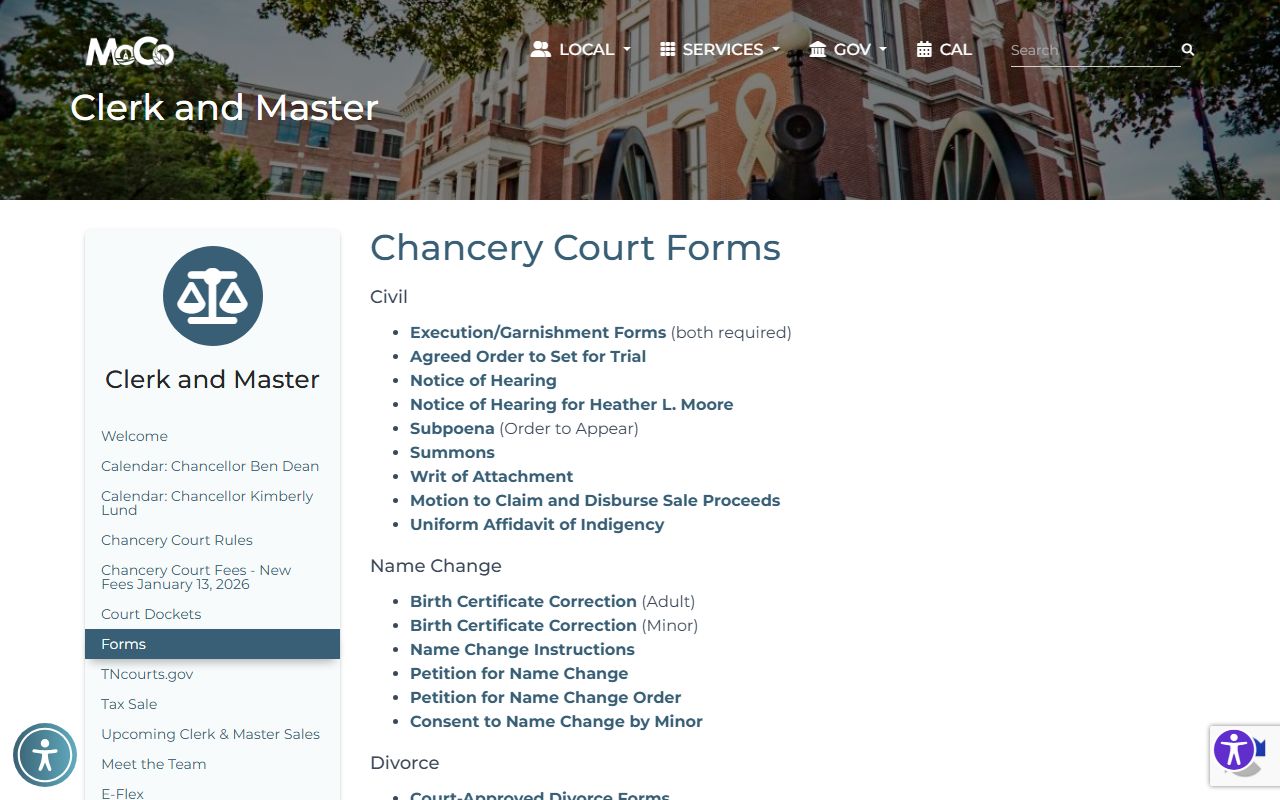
It includes the estate claim form, small estate forms, and the annual accounting used in Montgomery County probate. A Uniform Affidavit of Indigency is also available for those who cannot afford costs, and WebEx notice forms support remote appearances in some matters.
Probate Courts in Montgomery County
The Clerk and Master is the office to contact for probate. Heather L. Moore serves as Clerk and Master, and the office handles estate, family, and property matters in Chancery Court.
Clerk and Master, Chancery Court
2 Millennium Plaza, Suite 101
Clarksville, TN 37040
931-648-5703
Mon-Fri, 8:00 a.m.-4:30 p.m.
Probate Filing Fees
Probate filing fees are set by the Chancery Court schedule. The Chancery Court posted a new fee schedule effective January 13, 2026, so confirm the current amount with the Clerk and Master before filing rather than relying on an older figure.
| Item | Amount |
|---|---|
| Estate filing fee | Per current Chancery fee schedule |
| Small estate filing | Per current Chancery fee schedule |
| Certified copy | Per current Chancery fee schedule |
| Indigency affidavit | May waive filing costs if eligible |
The Clerk and Master can give the exact current amount and accepted payment methods. Estate costs can also include publication notices to creditors and, in larger estates, accounting and bond requirements. Asking the office for a full cost picture at the start helps an executor budget for the whole process, not just the opening fee.
What Montgomery County Probate Records Show
A probate file tracks an estate from opening to close. It can include the will, the appointment of an executor or administrator, an inventory of assets, creditor claims, accountings, and the final distribution. Guardianship and conservatorship files add medical and personal details about the protected person.
Because of those personal details, some probate filings are sensitive. Routine estate filings are generally public, but guardianship and conservatorship records may be restricted or redacted to protect health and financial information.
An interested party can usually follow an estate through the Chancery dockets and the Clerk and Master. Heirs, creditors, and named fiduciaries all have reason to check the file. Because the office does not run a public probate search portal, the practical route is to contact the Clerk and Master with the estate name or case detail and ask for the record or a certified copy. The court order closing an estate is part of the file too, which matters when an heir needs proof that distribution was approved.
Restricted Probate Records
Not every probate document is open. Records that include medical data, minor-identifying details, or protected financial information may be sealed or redacted under Tennessee confidentiality rules and Supreme Court Rule 34. To view a restricted probate record, a person usually must be an interested party or hold a court order.
If you are unsure whether a file is open, ask the Clerk and Master before you request it. The Chancery forms page also includes a public records request form and an interpreter request form, which shows the office has a formal process for both access and language help. When a guardianship protects a minor or an incapacitated adult, expect tighter limits on what the public can see.