
How to Search Montgomery County Traffic Court Records
Traffic cases in Montgomery County are searched through the same free portal as other court records. The Circuit Court Clerk's online system covers criminal and traffic cases from November 1, 1999 to current. Choose General Sessions as the court type, since most traffic matters are heard there, then search by name or citation-linked case number.
You will need a full name or the case number tied to the citation. The portal caps results at 2,500 rows and reads only the first ten words of a name query.
- Open the Circuit Court Clerk's online court records system.
- Select General Sessions as the court type.
- Search by party name, or by case year and case number.
- Check the search-enable box and run the query.
- Log in with the public credentials to view the full traffic record.
To pay a ticket, the county uses an online payment portal.
The screenshot below is the county's online payment portal.
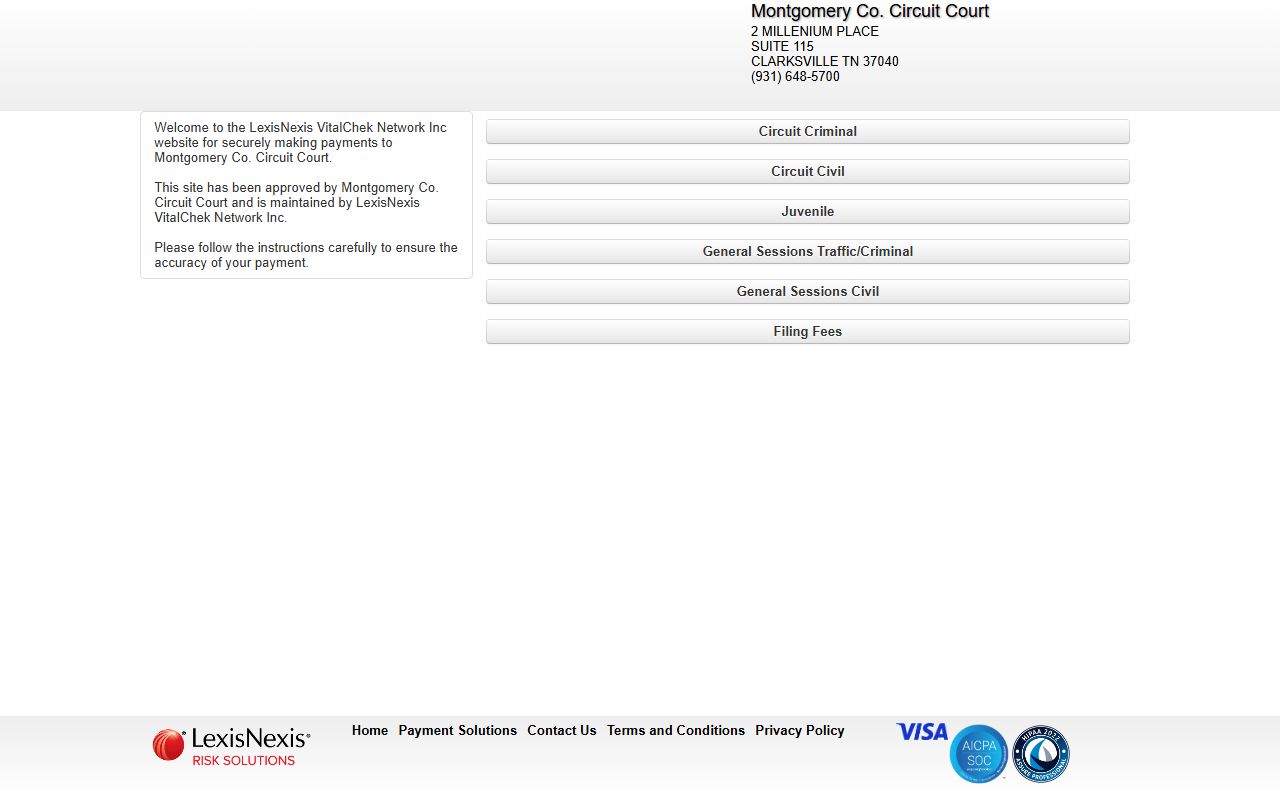
It lets you pay fines and costs without a trip to the courthouse, though contested tickets still need a court date.
Which Courts Handle Traffic Cases in Montgomery County
Most traffic citations are heard in General Sessions Court, which the Circuit Court Clerk clerks. Serious matters, such as a DUI charged as a higher offense, can move to Circuit Court. The table below shows where traffic matters land.
| Court | Traffic Role | Clerk |
|---|---|---|
| General Sessions | Most citations, misdemeanor traffic, payable offenses | Circuit Court Clerk |
| Circuit Court | Serious cases and appeals from General Sessions | Circuit Court Clerk |
| Municipal Court | City ordinance traffic matters | City court clerk |
Because the Circuit Court Clerk clerks General Sessions, most Montgomery County traffic court records sit with that office.
Types of Traffic Cases on Record
Traffic records cover more than speeding tickets. They range from minor payable offenses to serious criminal charges. The list below covers the common types.
- Moving violations like speeding and running a light.
- Non-moving and equipment violations.
- Driving on a suspended or revoked license.
- Reckless driving and other misdemeanor traffic charges.
- DUI and DWI, which are criminal matters.
A payable ticket can often be handled without court, while a criminal charge like DUI requires a court appearance.
What Montgomery County Traffic Court Records Show
A traffic record ties the citation to the case and its outcome. It shows who was cited, the charge, the court, and how the case ended, plus any fine or cost owed.
| Field | What It Shows |
|---|---|
| Citation / Case Number | The court file tied to the ticket. |
| Driver Name | The person cited. |
| Charge | The traffic offense alleged. |
| Court Date | The set hearing date, if any. |
| Disposition | The outcome, such as paid, dismissed, or convicted. |
| Fines and Costs | The amount owed or paid. |
The court record is not the same as your state driving record, a point covered further below.
Searching by Citation Number vs by Name
You can find a traffic case two ways. A name search is easy when you do not have paperwork. A case-number search is precise when you have the citation. The portal accepts either a name or a case reference in the Party Name box, but not both at once.
| Method | When to Use | Notes |
|---|---|---|
| By name | No citation handy | Use full first and last name for the tightest match. |
| By case number | You have the citation | Enter only the final numeric part of the case number. |
If a name returns too many rows, the Filter textbox on the results narrows the list in real time.
Paying or Contesting a Montgomery County Traffic Ticket
You have a choice with most tickets. Pay it and resolve the case, or contest it and ask for a court date. Paying a payable offense is often treated as an admission, so think it through before you pay. Contesting means appearing in General Sessions on the set date.
- Read the citation for the court date and any payable amount.
- To pay, use the county online payment portal or pay the clerk.
- To contest, appear in General Sessions on the scheduled date.
- Ask the clerk about a continuance if you need more time.
- Check whether the driver improvement program fits your case.
Court dates can reset, so confirm yours with the Circuit Court Clerk before you appear.
Public Access Laws for Traffic Court Records
Traffic court records are court records, so they follow the same access framework. Tennessee Supreme Court Rule 34 opens court records to the public unless an exception applies, and the Tennessee Public Records Act covers related government records. Personal identifiers are redacted, and sealed or expunged matters are not shown.
Note: Traffic court records are generally public, but your state driving record is held separately and has its own access rules.
Court Traffic Records vs State Driver Records
This is the distinction that trips people up. The court traffic record is the case file the Circuit Court Clerk keeps. The state driver record is a separate file the Tennessee Department of Safety and Homeland Security keeps about your license and points. They are not the same, and fixing one does not fix the other.
| Point | Court Traffic Record | State Driver Record |
|---|---|---|
| Who keeps it | Circuit Court Clerk | Tennessee Department of Safety |
| What it holds | The case, charge, and disposition | License status, points, and history |
| Where to access | County court records portal | State driver services |
| How to correct | Through the court | Through the state agency |
If a case was dismissed in court but still shows on your driving record, you may need to contact the state agency separately.
CDL and Commercial Driver Records
Commercial drivers face stricter rules. A CDL holder can lose the license for offenses that a regular driver might shake off, and some diversion options are not open to them. A traffic conviction can affect both the court record and the commercial driving record at the state level.
Commercial drivers should be careful before paying a ticket, since a quick payment can count as a conviction that follows the CDL. When in doubt, talk to an attorney before resolving a commercial traffic case.
DUI and DWI Cases
DUI and DWI are criminal charges, not simple traffic tickets. They cannot be paid off like a payable offense, and they require a court appearance. Because they are criminal, they appear in the criminal side of the court record and can carry jail time, license loss, and other penalties.
For the criminal side of a DUI, including booking and case history, see the arrest records page and the court records portal. A DUI can also trigger a license suspension handled by the state, separate from the court case, which is one more reason to take the charge seriously.
Deferred Adjudication and Defensive Driving Course
Montgomery County offers a driver improvement program through General Sessions Court. Finishing an approved course can change how a citation is handled and reported, which helps keep points off a record. The Circuit Court Clerk keeps an eligibility page and registration forms, including an option for out-of-county drivers.
The screenshot below is the General Sessions driver improvement program eligibility page.
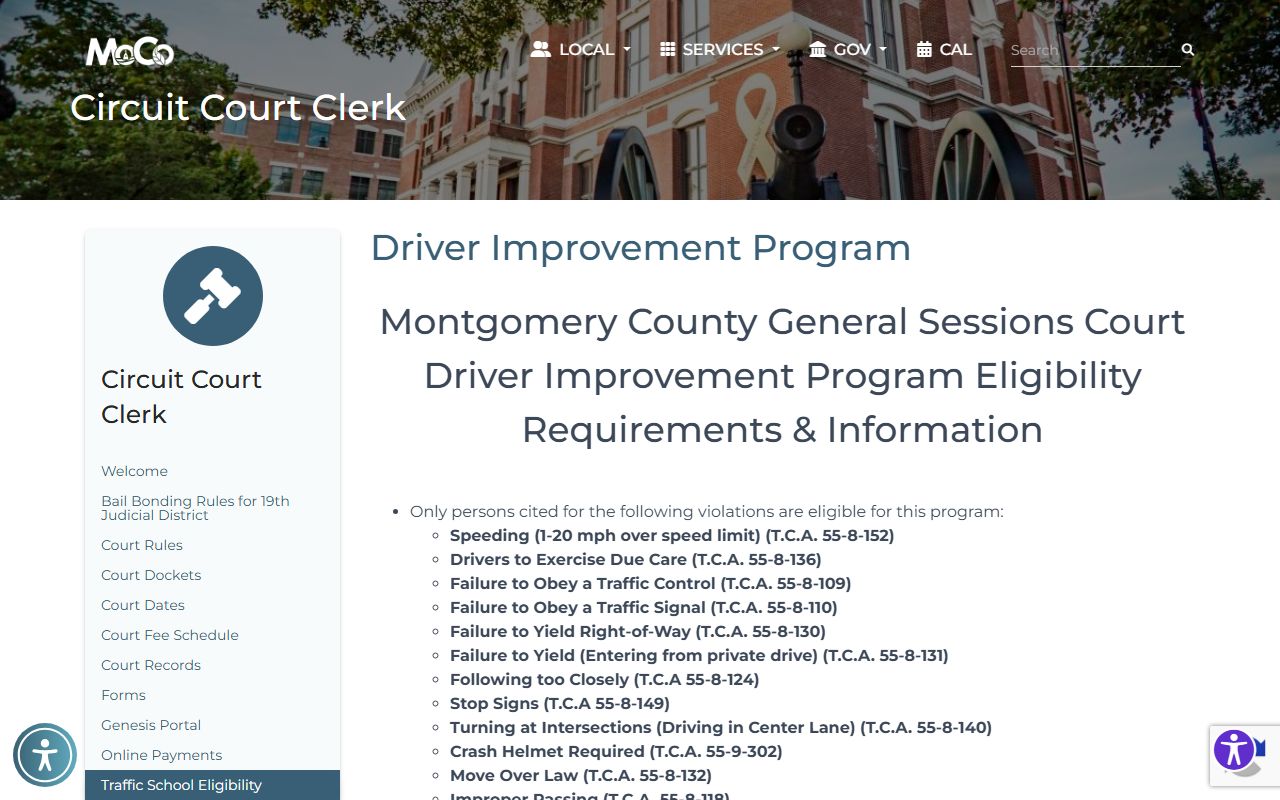
It explains who qualifies for the traffic school option and how to register.
Sealing or Expunging Traffic Records
Some traffic matters can be expunged when the case qualifies, such as a dismissal or a not-guilty result. Expungement removes the eligible record from public view under Tennessee Code § 40-32-101. A person files in the court where the case began, and the Circuit Court Clerk posts the expungement forms.
A conviction is harder to clear, and a criminal traffic matter like DUI follows the rules for criminal records. The arrest records page covers expungement eligibility in more detail.
Fees for Traffic Record Copies
The online search is free. Paying a fine, ordering a copy, or getting a certified copy carries a fee set by the court schedule and the payment portal. Confirm the current amount before you pay.
| Item | Amount |
|---|---|
| Online traffic record search | Free |
| Ticket payment | Through the county payment portal |
| Certified copy | Per court fee schedule |
| Card processing | Set by the payment processor |
The Circuit Court Clerk can confirm exact copy and certification charges.