
Arrest Records in Montgomery County
Arrest records show who the Montgomery County Sheriff's Office has booked into the county jail. They start at booking, when a person is processed, charged, and held or released. The Sheriff's Office runs free public inquiry tools for the inmate roster, the booking log, and warrants. A Montgomery County arrest records search usually starts with the booking log or the jail roster, then moves to the court file once a case is opened.
An arrest is not proof of guilt. It only means law enforcement believed there was cause to take a person into custody. The court case that follows is where guilt or innocence is decided.
The booking log is advertised as a view of the past four days of bookings at the jail.
The screenshot below is the MCSO booking log.
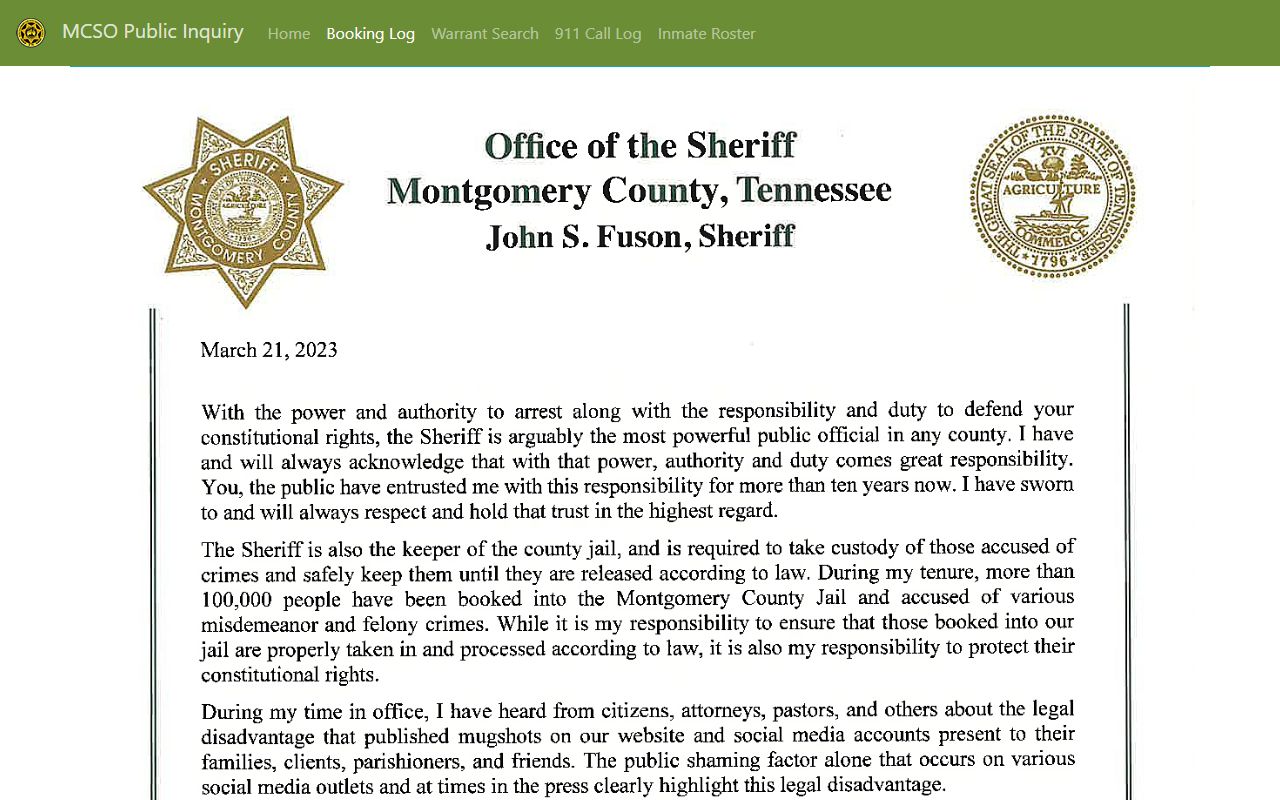
It lists recent bookings, which is the fastest way to spot a recent Montgomery County arrest.
How to Search Montgomery County Arrest Records
For recent arrests, start with the Sheriff's Office tools. For the court case tied to a charge, use the Circuit Court Clerk's portal. The two systems answer different questions: one shows custody, the other shows the case.
- Open the MCSO booking log to see recent bookings.
- Search the inmate roster by name to check current custody.
- Run a warrant search to see if a person has an active warrant.
- Use the court records portal to find the criminal case and its charges.
- Confirm any match with the Sheriff's Office at 931-648-0611.
The booking log and roster answer the custody question, but they do not show how a case ends. For that, you have to follow the charge into the court system, where the plea, trial, or dismissal is recorded. Keep both the booking date and the case number handy as you move between the two systems.
Arrest Records vs. Criminal Court Records
An arrest record and a criminal court record cover different stages. The arrest record is the law enforcement side. The criminal court record is the case the District Attorney files and the court decides.
| Point | Arrest Record | Criminal Court Record |
|---|---|---|
| Who keeps it | Sheriff's Office | Circuit Court Clerk |
| What it shows | Booking, custody, charges at arrest | Filings, pleas, disposition, sentence |
| Where to find it | MCSO public inquiry tools | Online court records portal |
| Outcome included | No | Yes |
For the full case history, the court records page is the better source.
Charges vs. Convictions
This is the line that matters most. A charge is an accusation. A conviction is a finding of guilt by plea or verdict. Many charges end in dismissal, a not-guilty result, or a nolle prosequi, where the state drops the case.
| Term | Meaning |
|---|---|
| Charge | The offense a person is accused of at arrest or by filing. |
| Conviction | A guilty plea or a guilty verdict entered by the court. |
| Nolle prosequi | The prosecutor chooses not to pursue the charge. |
| No true bill | A grand jury declines to indict. |
Reading the disposition field is the only reliable way to tell a charge from a conviction.
Sealed vs. Expunged Records
Tennessee lets some records be expunged, which removes them in the eyes of the law. The Tennessee Administrative Office of the Courts explains the process on its expungement page, which cites Tennessee Code § 40-32-101. Sealing limits public access without destroying the file. Expungement is broader and removes the eligible record from the public database.
The expungement page lists the eligible scenarios.
This image is the Tennessee AOC expungement page.
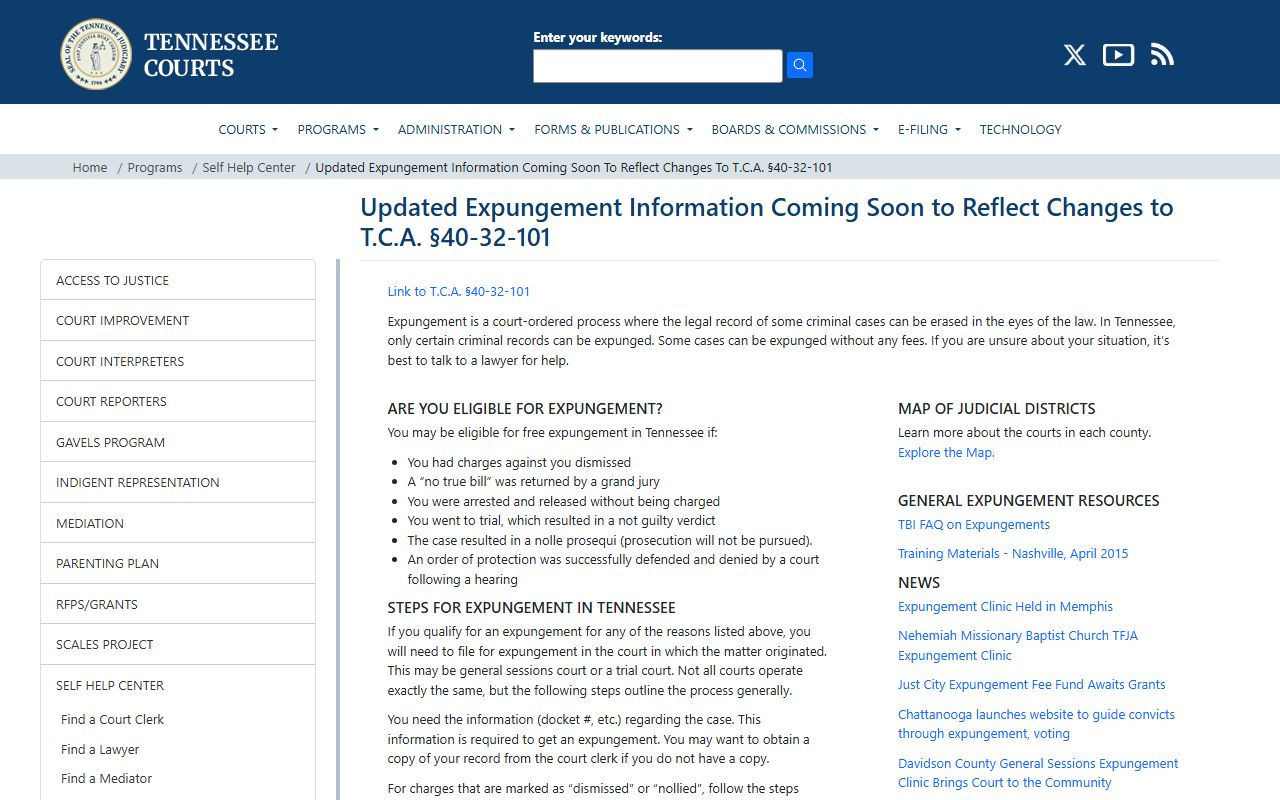
Free expungement may apply after a dismissal, a no true bill, a not-guilty verdict, or a nolle prosequi.
| Action | Effect |
|---|---|
| Sealed | Public access is restricted; the file still exists. |
| Expunged | The eligible record is removed from public view. |
A person files for expungement in the court where the case began. The Circuit Court Clerk posts local expungement forms and instructions, including a fillable expungement order and separate instructions for conviction and partial expungement. Common reasons a request fails include filing in the wrong court, an offense that is not eligible, unpaid court costs, or missing case numbers. Getting the case details right before filing saves a return trip.
Mugshots and Booking Photos
Booking photos are taken during the intake process. The county's public booking log and roster focus on names and booking data, and the inspected public results did not expose a mugshot link. People should be careful with third-party mugshot sites, which often charge to remove a photo and are not official sources.
For official booking information, contact the Sheriff's Office directly rather than relying on a private site. The county's roster results in the inspected public view showed only last name, first name, and middle name, plus an update timestamp. No mugshot, booking number, or charge detail was exposed in that list, so calling the inmate division is the way to confirm details.
Statewide Criminal Records Search
For records beyond the county, the Tennessee Bureau of Investigation maintains state criminal history and the sex offender registry. Felony offenders sentenced to state prison are tracked by the Tennessee Department of Correction rather than the county jail. The released inmates page covers the state and federal locators in detail. A single person's record can span all three levels: a county arrest, a state felony sentence, and, in rare cases, a federal charge.
Federal charges are separate. Those cases run through the U.S. District Court for the Middle District of Tennessee and are searched through PACER, not the county clerk.
The Tennessee Bureau of Investigation hosts the state sex offender registry, which updates daily.
This screenshot is the TBI sex offender registry information page.
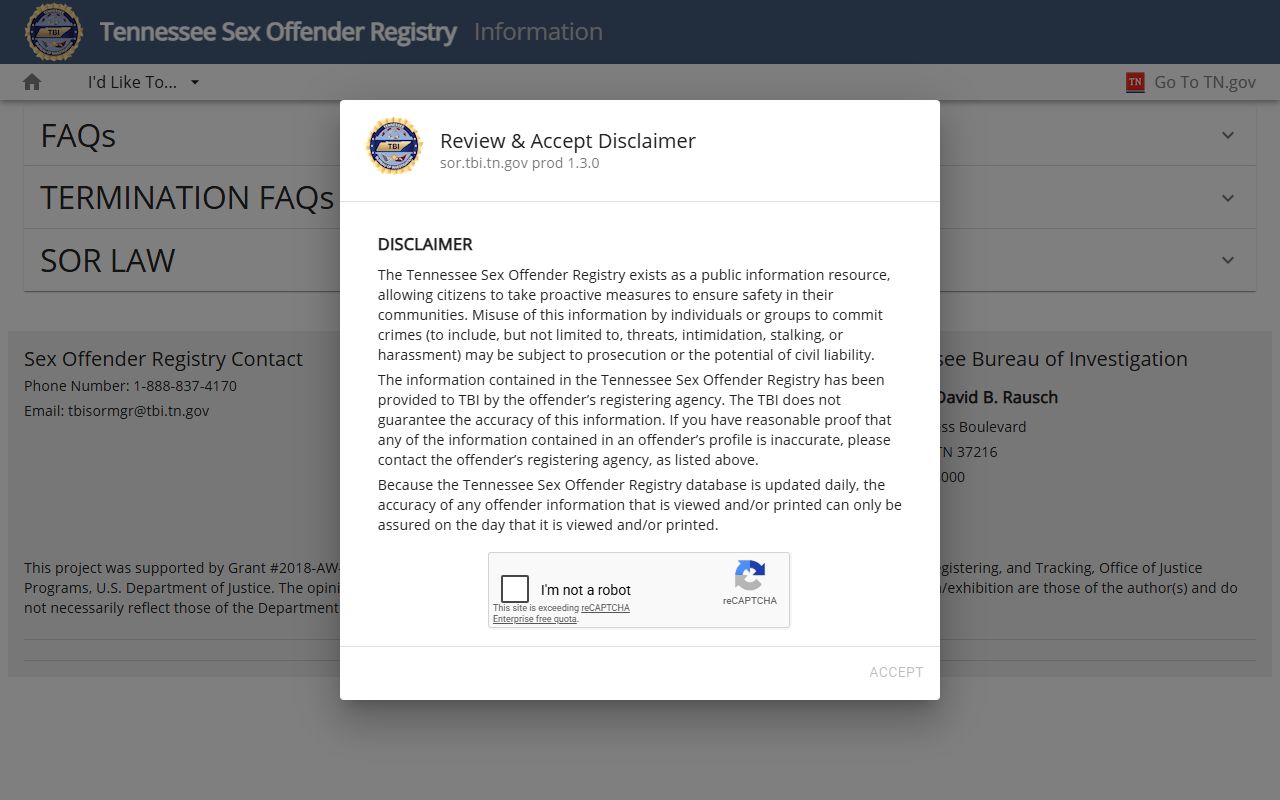
The TBI warns that registry accuracy is only assured on the date the page is viewed or printed.
Background Check Considerations
Public court and arrest records are not the same as an FCRA background check. The data on a public site may be incomplete or out of date, and it cannot be used for credit, employment, tenant, or insurance decisions. A name match alone is risky, because two people can share a name and birth year. Always confirm identity with the case number and the originating office before drawing any conclusion about a person.
Note: Do not use Montgomery County arrest or court records for any FCRA-regulated purpose; use a licensed screening provider for those decisions.
Restricted Criminal Records in Montgomery County
Some criminal records are closed. Juvenile records are confidential. Sealed records and protected personal identifiers are withheld under Tennessee Code § 10-7-504 and Supreme Court Rule 34. Expunged records leave the public database. Law enforcement investigative and intelligence files are treated differently from ordinary public court records.
To view a restricted file, a person usually must be a party or hold a court order. Grand jury material is also not an ordinary public record, even when a no true bill later matters for expungement. If you believe a record should have been expunged but still shows up, the originating court is the place to fix it, because the clerk removes the record from the local database once the order is entered.